A Brief History of Eastern Meditation
Most scholars agree that meditation as we know it today has its roots in ancient India, somewhere between 3000 and 5000 BCE. Cave drawings from this time show people sitting in meditative postures with their eyes closed, suggesting meditation was well utilised at the time. It may be that contemplative practices predate this by quite some time and really, it depends on how meditation is defined. Some suggest the Indus Valley Civilisation took inspiration for meditation from the ancient Egyptians–ancient Egyptian hieroglyphics show people and Pharaohs in yogic postures, suggesting a link. Some have even suggested that meditation might be as old as humanity itself - perhaps even Neanderthals meditated. As I said, it really depends on how meditation is defined.
The earliest written records of meditation exist in the Vedic scriptures of the Indus Valley Civilisation, written between 1200 BCE and 1500 BCE. The Vedas reference “asanas” or positions, which, while used to refer to most yoga positions today, originally referred only to sitting meditation. Regardless of when its official origination lies in terms of recorded history, it seems likely that practices enabling people to connect with a spirituality, higher-power, god, gods or the divine essence that represents greater meaning, go back a very long time indeed.
While the earliest histories may be a little diffuse, things start to get a little clearer (and better recorded) following the life and time of Siddhartha Gautama, aka The Buddha (563 BCE - 480 BCE). The life of the Buddha, and particularly his enlightenment, mark the start of the Buddhist tradition and the crystalisation of mindfulness meditation as a vehicle to reach liberation. While some techniques such as Vedic meditation and practices giving rise to Kemetic yoga predate traditional mindfulness, in many ways Buddhist mindfulness, and particularly its focus on awareness, represents the roots of the tree from which most other modern meditative techniques have arisen, especially the insight traditions.
From the time of the Buddha until the 20th century meditation existed in the East in many forms, and new meditation practices continued to be developed. Around the time of the Buddha, meditation was also growing in popularity in China, with the philosopher and teacher Lao-Tze, the founder of Taoism, promoting the value of wisdom in silence. Meditative techniques continued to be developed into the 20th century with Vipassana meditation being redeveloped in Burma in the 18th century (leading to the Vipassana movement of the 20th century) and Transcendental meditation being developed by Maharishi Mahesh Yogi in India the 1950’s. In essence, for over 5000 years the East has been a rich breeding ground for connection with the divine, and the attainment of tranquility and wisdom through meditation.
The first references to eastern meditation in the West are in the 1700s, and come from translations of ancient eastern scripts such as The Upanishads, The Bhagavad-Gita and the Buddhist Pali Canon. The word meditation comes from the latin “meditatum” which means “to ponder” and prior to the introduction of eastern meditation, the word was used to describe deep, personal, philosophical thought. To an observer, a state of deep thought would have been what eastern meditation resembled, even though in some ways it’s quite the opposite! Until the very late 19th and then 20th century, this form of eastern inquiry remained the interest of intellectuals, particularly philosophers, and was by no means common practice.
In 1893 the Indian Guru Swami Vivekananda delivered an iconic speech to the World's Parliament of Religions, where he introduced Hinduism to America and called for tolerance of all religions. This sparked an interest in Eastern philosophy and by the 1930s, the first references to meditation in academic research were made. By the 1950’s Maharishi Mahesh Yogi had emigrated to America, bringing his Transcendental Meditation practice. This became popularised, in particular, by the Beetles and other celebrities. At this time meditation was still associated with the counterculture and was not part of the mainstream.
Meditation entered the mainstream through the work of John Kabit-Zinn, who in 1979 opened the Stress Reduction Clinic at the University of Massachusetts and developed the Mindfulness-Based-Stress-Reduction program. Much credit is also given to Vietnamese Zen Buddhist monk Thích Nhất Hạnh, who, from his exiled home in France, toured extensively across the West, and wrote numerous entry level books on meditation and mindfulness. By the late 1990s Oprah was interviewing Depak Choprah and meditation was well and truly recognised for its benefits to mental health and inner well-being.
Today, Google Scholar lists hundreds of thousands of academic articles referencing meditation, and it is accepted in medical and therapeutic industries (as well as by me!) as one of the most profound and accessible tools for personal and spiritual development.
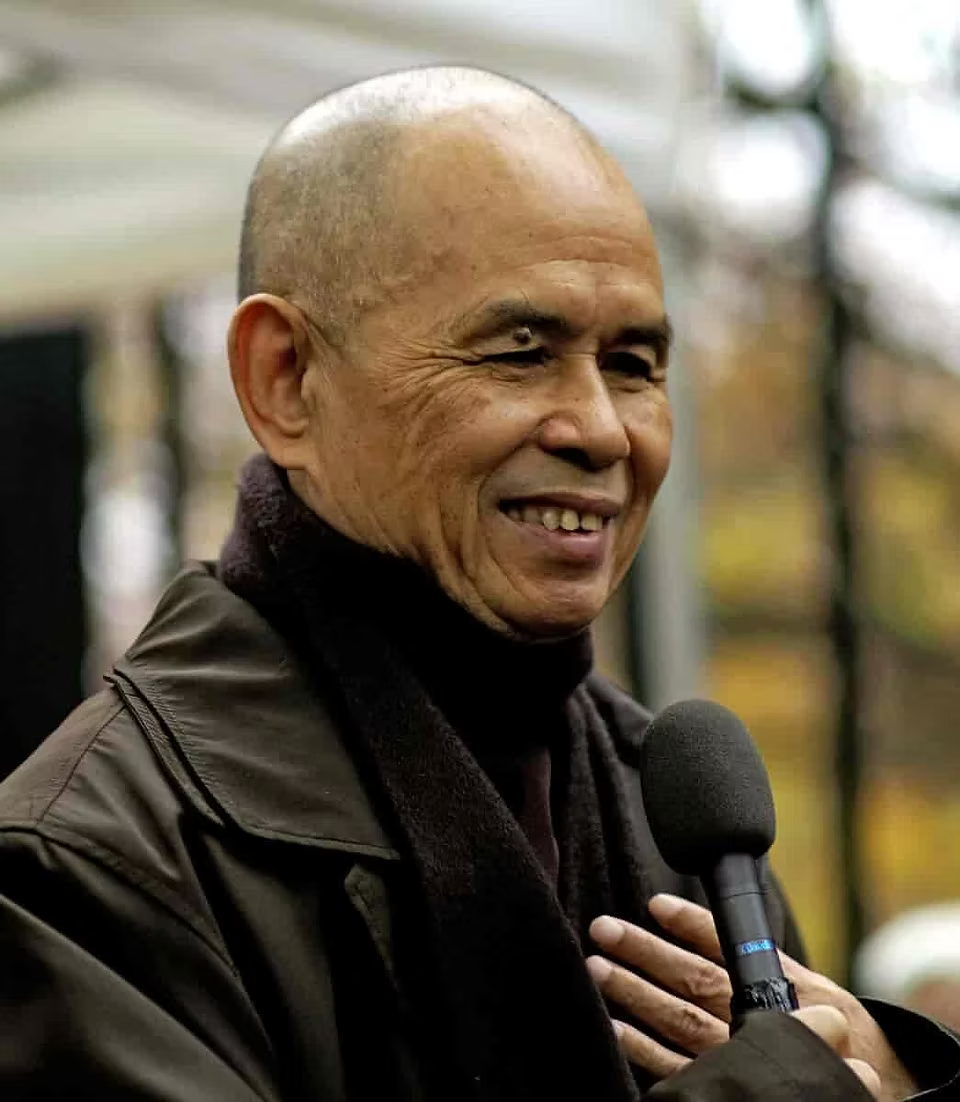
Thích Nhất Hạnh, one of the fathers of meditation in the west
Bay of Islands, New Zealand
hello@meditatewithfletch.co.nz




Site Map
Subscribe to the Newsletter
© 2026 Meditate with Fletch