How to: Mettā Bhāvanā
The Metta Bhavana is a meditation that cultivates compassion, kindness and skilful action. Creating this sort of shift within ourselves can be difficult when we have been raised in a world geared towards ego, self and scarcity, but it is possible. Acting with metta (loving kindness) is like being a beacon in a storm, and it doesn’t take long to start shining.
The practice of metta can be very wide ranging, you can go almost anywhere with it. Metta is “the most fundamental positive emotion”, so anytime you are accessing kind, warm, accepting feelings, you are practicing metta. For the purposes of this how-to guide, I am intentionally keeping things quite brief. For more detail on the breadth of metta, please attend one of my 102: The Metta Bhavana, Compassion and Skilful Action courses.
Designate yourself some time in your day for your meditation, aim for 20 to 30 minutes, or more. Due to the partitioned nature of this meditation, it is easy to sit for longer than you may usually be used to (and this is a good one to sit for longer with!). I recommend a minimum of 5 minutes each for the middle sections, and at least a couple of minutes of breathing at the start and end to settle in and exit.
A full 30 to 35-minute practice may go as follows:
Settle with breath. 2-5 mins.
Metta to self. 5 mins.
Metta to a near and dear friend. 5 mins.
Metta to a neutral person. 5 mins.
Metta to a difficult person. 5 mins.
Metta to all sentient beings. 5 mins.
Sit in open awareness. 2-5 mins.
Feel free to extend these sections as long as you like. If you want a shorter practice, I recommend removing sections as opposed to shortening them. As a minimum, do sections 1, 2, 6 and 7.
In preparation for this meditation you will need to think of three people and have them ready in the back of your mind:
A near and dear friend. This is someone you find it easy to generate positive feelings towards.
A neutral person. Someone you don’t have much feeling for one way or the other. This is often someone you don’t know very well, often just by face. A supermarket checkout operator or the guy in the dairy is my usual go-to.
A difficult person. Someone you are currently having trouble with at the moment. Perhaps someone you’ve recently had an argument with, or the person who cut you off in traffic yesterday, etc.
When you have all this ready, find your meditation posture, start your timer and close your eyes. Use the first few minutes to settle in and find your breath. This is important because becoming present is a pre-condition of accessing metta. Indeed, Thich Nhat Hanh writes, “When we are mindful, touching deeply the present moment, the fruits are always understanding, acceptance, love, and the desire to relieve suffering and bring joy”. This is metta.
Once you’ve settled in, it can be helpful to bring to your mind a time in your life when you felt very happy. This may be a single event or a period in your life. What is important is that it makes you feel happy and warm in your body. If a time like this is particularly difficult to access, ask yourself if you can find a wish that you will be happy one day, we can usually always find this wish. If even a wish is hard to find, can you find gratitude for anything, even just the opportunity to practice and learn?
Take a few moments to tune into how this time in your life or wish feels in your body. This is very important. We can be tempted to dwell in our mind during this meditation as we repeat phrases that are essentially thoughts. But the phrases we use are only cues, guides. The important work is in the body. Stay embodied. The positive feelings in your body are your anchor for this meditation and you can return here at any stage.
When you have that embodied feeling, bring a sense of yourself to your mind. This may be a photo, your image in a mirror, or the sense of yourself sitting there in meditation. Firstly, notice how you feel towards yourself. This is important because this is our starting point. It doesn’t matter what it is, just notice it. Sometimes we find things we may not think we think about ourselves. For now, just notice it.
From here, start softly repeating the following phrases in your mind, remaining anchored in the body:
May I be happy
May I be healthy
May I be peaceful
May I live with loving kindness
Do this for at least five minutes, remaining embodied, and bringing yourself back when you get distracted as youn would in any other meditation. At any time you can come back to your breath, or the feelings of metta in the body. Go slow and really try to feel it.
When your timer goes off, finish the round of phrases you’re on, thank yourself for your practice, and allow the image or sense of yourself to fade from the mind.
Next, bring in your near and dear friend and repeat the process for them. Notice initial feelings, then start to direct metta using the phrases:
May you be happy
May you be healthy
May you be peaceful
May you live with loving kindness
Again, do this for at least five minutes, remaining embodied, and bringing yourself back when you get distracted.
Repeat this for your neutral person, difficult person and all sentient beings. For the section on all sentient beings, use the phrases:
May all be happy
May all be healthy
May all be peaceful
May all live with loving kindness
At the end of the all sentient beings section, give yourself at least a few minutes of sitting in the nice openness you’ve created to let the practice sink in. Don’t be in a rush to exit the meditation.
Thank yourself for your practice, and if you like, dedicate any merit you have gained to the release of suffering of all beings. This is a powerful act of compassion.
Additional notes:
When you notice initial feelings you have toward yourself or someone else, don’t be dismayed if they’re not feelings of metta. Sometimes we have anger, hatred, disappointment, or perhaps very little feeling whatsoever toward someone. This is OK. Recognise that as long as you are sitting with those feelings in your awareness, just observing them and not actively engaging them (like making a plan to slash some tyres or spread a rumour), the practice will be slowly turning them into more skilful emotions. The power is in the awareness of the emotion because awareness itself is skillful. Awareness is a tool that develops metta. More on this in my Metta Bhavana course.
If you find yourself struggling at any point, come back to your wish to be happy, or to a feeling of gratitude. Even gratitude toward a difficult person is accessible because you know you will have grown from the pain.
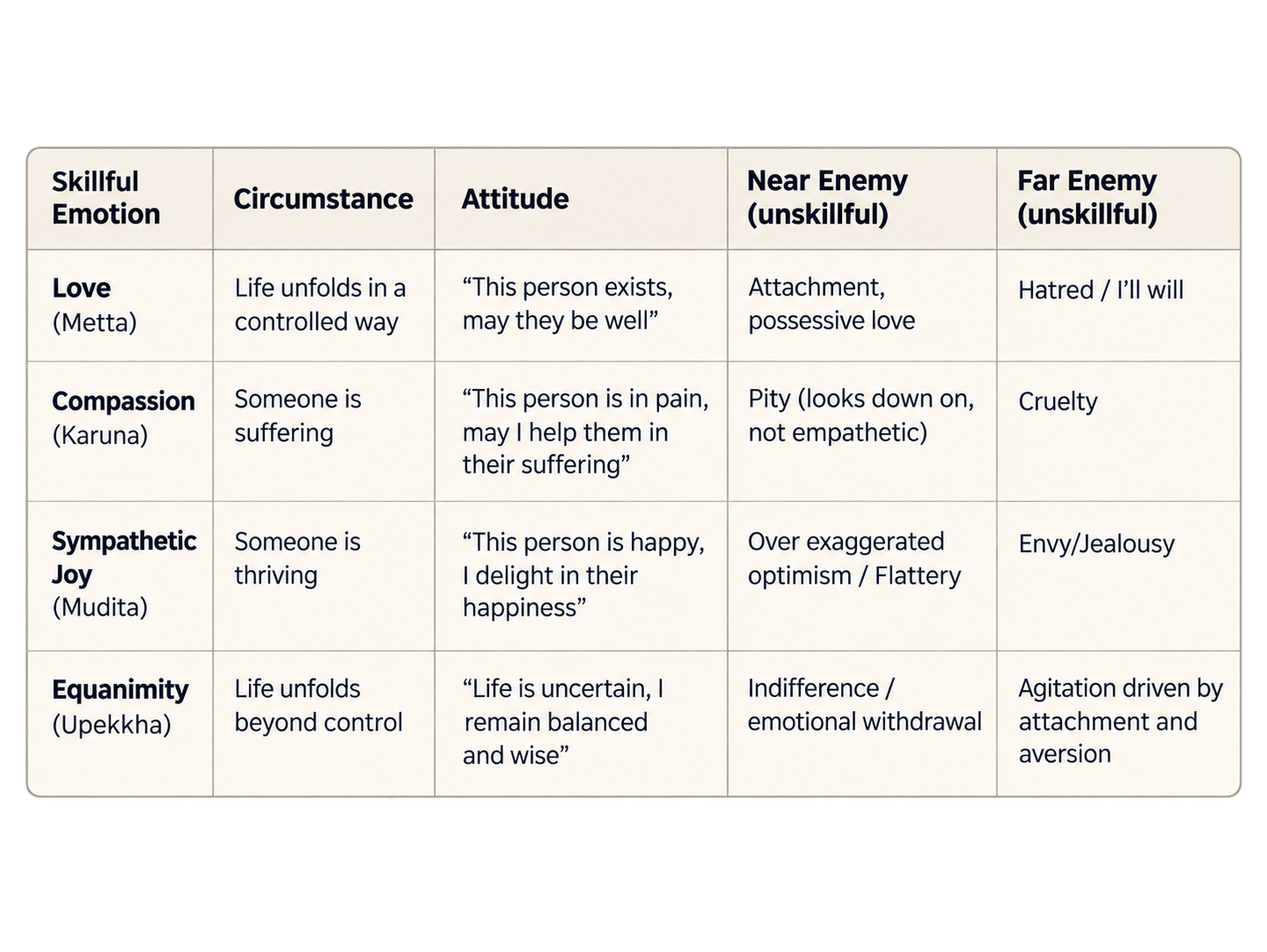
It is good to get to know the four Brahmavihāras (the four divine abodes) and their ‘near’ and ‘far enemies’. This is because you want to keep an eye out for the enemies (the unskilful counterparts of the emotions) and not actively grow them. This is covered in my 102: Metta Bhavana course and overviewed in the table below.
Feel free to try your own phrases. Anything that conveys positivity is usually good. And you may find yourself using different phrases in different sections. Try to make it personal if you can, that will make it easier to access metta. For example:
May I/you be protected and safe.
May I/you be happy and at ease.
May I/you be well.
May I/you care for myself/yourself wisely.
May I/you be at peace.
May I/you be calm
May I/you find inner peace
May my/your body be healed
May I/you be healthy
May there be an end to suffering
May all be metta
The Four Brahmāviharas

Bay of Islands, New Zealand
hello@meditatewithfletch.co.nz




Site Map
Subscribe to the Newsletter
© 2026 Meditate with Fletch