What are the Benefits of Meditation? Training Skilful Mental States
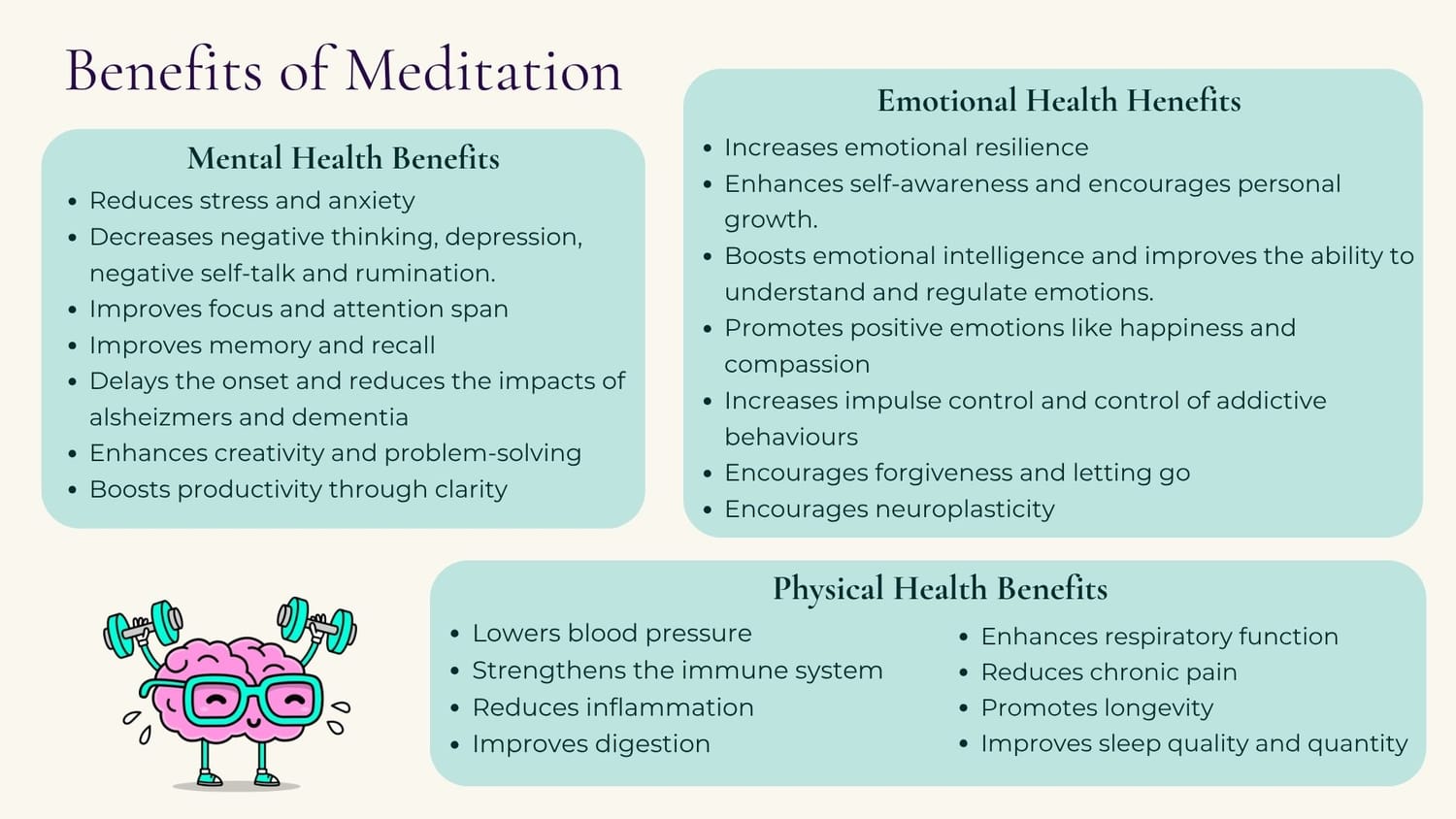
So, what are the benefits of meditation? It’s a reasonable question. Maybe you’ve heard that meditation can reduce stress, improve sleep, help with anxiety and depression, sharpen concentration, or improve your physical health. Yes, this is all true, but this isn’t what I want you to understand.
Meditation is best understood not as a linear process where you do X amount of meditation and receive X, Y and Z outcomes, but as a fundamental shifting of our frame of reference and way of approaching the world–a shifting from what we call “unskilful” to “skilful” mental states. This shifting is what opens the Pandora’s box of possible mental, emotional, physical and spiritual outcomes of regular practice. I would even argue that to understand meditation in this way is actually the point of it–it’s a view that itself encourages the kind of opening to growth that meditation promotes.
My starting point to experiencing the world, which includes all my mental baggage–my habits, fears, desires and repulsions, etc–is different to yours, which is different to Prince Harry’s, which is different to your mate Steve’s. Therefore, the impact that meditation has on our lives will also be different. We all have unique sets of starting conditions. This is why there is no guarantee of any particular outcomes. What we can be certain of though, is that inhabiting skilful mental states always leads to more peace and contentment, and a more easeful way of life.
Skilful Mental States
A skilful mental state is a state of mind that leads towards positive outcomes rather than suffering. Specifically, in a Buddhist context, skilful mental states lead toward seeing life more clearly, and so acting in a beneficial and productive way. They include states like presence, concentration, compassion and kindness. An unskilful mental state does the opposite and keeps us bound to our mistaken views, ill-conceived ideas, or poorly thought out intentions. Think things like anger, jealousy and disingenuousness. Ever wondered why you keep making the same mistake over and over? You’re stuck in a loop of unskilful mental states.
Every situation can be tackled skilfully (and so shift us toward easefulness) or unskilfully (and so shift us toward tension). Think about, for example, any undesired situation, and the contrasting reactions of anger and acceptance. The same event can catalyse different results depending on the starting point of the mind. One results in judgement, tension and reaction, while the other results in letting go and spaciousness. Same situation, different starting points, different results.
This sort of crossroads is happening all the time. At every moment in life, we're approaching our experience from some kind of mental reference point. Sometimes it’s skilful, sometimes it isn't. The problem is that it appears that we have no choice in the matter. Something pisses us off and we just get angry. Or something makes us anxious and we think, “This is making me anxious”. Whatever emotion we become–jealous, resentful, defensive, fearful–it’s as if they’re simply happening to us.
But we do have a choice, and how much of a choice depends on how much mental training we’ve done to get ready for the shit that life throws at us. This is what meditation is actually doing, it’s training us to be able to access the skilful when it matters. We are literally sitting there on our cushions practicing inhabiting these skilful states. It’s a bit like doing your natural disaster emergency preparation with your family. If you have done a few run-throughs and know where the first aid kit is, where the torches are, and where the meeting point is, when the time comes to take action, you’re ready.
This is why meditation is not just about relaxing and taking some time out, it’s an active pursuit to train the mind to be more capable and resilient in the face of adversity.
Let’s now look at some of the core skilful mental states we train during meditation and how they help our lives.
Presence
Presence is mindfulness, being present. To train ourselves to be present is to train ourselves off the autopilot program that we run on most of the time.
Consider this: At the end of the day, us humans are just packets of flesh, bone and nerve cells running around thinking we’re in control when actually, it’s most often our emotions that are in the driver's seat. We act in particular ways because we’re angry, because we’re anxious, because we’re [insert your favourite emotion here]. Most of the time we don’t volunteer our reactions, they just happen.
Presence gives us the ability to see, and then interrupt the automatic reactions. Instead of being inside the emotions and being controlled by them, we start to separate ourselves from our emotional experience and gain the agency we so dearly desire. This ‘separation from experience’ might sound daunting at first, even dissociating, but it’s actually a very powerful position to take, and we end up with more control over our lives, not less.
In my classes I talk a lot about the difference between reacting and responding. A response is considered, a reaction is not. A response is seeded by mindfulness–presence.
Concentration
Along with presence, one of the first things meditation trains is concentration. In a practice such as mindfulness of breathing, we take something very simple (the breath) and softly, but intently, place our focus on it. Soon enough, the mind wanders off into thinking about this, that and the other. When we notice we’ve drifted off, we come back and we try again. By repeating this process we train our minds and develop our faculty of concentration.
Greater concentration results in less stress and anxiety. This is because stress and anxiety is a product of an agitated, distracted mind. Oh you have to do 100 things at once do you? No wonder you’re stressed! Concentration is the antidote to stress.
Less stress–and so less stress hormones pumping through the body–is also the key to the laundry list of possible positive physical health outcomes of meditation including…. lower blood pressure and improved cardiovascular health; lower inflammation, potentially resulting in reduced risk of arthritis, diabetes, some cancers; reduced risk of Alzheimer's, dementia and cognitive decline; better digestion and reduced symptoms of IBS; better immune functioning; better sleep; reduced muscle tension and chronic pain; better respiratory function; and potentially even slowing the process of aging.
All just by concentrating more…
Mettā - Compassion and Kindness
The third skilful mental state I'd like to explore here is mettā. Mettā is often translated as loving-kindness, but it is best described as the most fundamental positive emotion. It's the capacity to care, to appreciate, to forgive, to be grateful, to have compassion for ourselves and others. Most of us know intuitively that when we act with these attitudes, life turns out for the better. But little do we appreciate that these qualities of mind can be deliberately cultivated.
In Mettā Bhāvanā (loving-kindness) meditation, we intentionally develop these qualities. When we do this, we usher the mind in that direction. Just like repeatedly training the mind on the breath develops concentration, repeatedly training the mind to abide in kindness (you wouldn’t believe it) teaches the mind to be more kind! And when we act with kindness, the world is a kinder place.
The Mettā Bhāvanā is a powerful and transformative practice.
So, those benefits?
This brings us back to the original question, what are the benefits of meditation?. Does it reduce stress? It can. Can it improve concentration? Yes. Can it help with anxiety, depression, burnout, sleep and mental wellbeing? Yep, that too. Can it influence physical health? You betcha. But none of this is guaranteed and it all depends on you, your body and your story. What can be guaranteed (if you stick at it!) is a shifting in the way that you relate to the world, and it is this shift that paves the way for beneficial physical, mental and emotional health outcomes.
A last word here needs to go to expectation. As I explain in this article, expectation of any particular outcome will usually only push it away. It will also prevent other, unexpected but desired outcomes from arising. The best expectation is no expectation. I challenge you to even let go of the idea that this ‘shifting into skilful mental states’ will occur. Just like Alice following the White Rabbit into its hole, all you need is a little bit of curiosity to see what happens. I’d add to that simile a side of perseverance rooted in the view that there is a way out of suffering, and sprinkle of faith in this millenia old mechanism, and you’ll have yourself a practice that is fruitful, stable, and enlightening for years to come.

Bay of Islands, New Zealand
hello@meditatewithfletch.co.nz




Site Map
Subscribe to the Newsletter
© 2026 Meditate with Fletch